
Union County Arrest Report Archive
Start with the Sheriff's Daily Media archive. It is the county's official multi-day source. The page groups calendar-date PDFs inside month and quarter ranges, and coverage runs from searchable 2024 files up through 2025 and 2026 material. This is not a rolling seven-day booking table. Each report opens date by date. The narratives mix warrant pickups, custody transfers, crashes, disputes, and agency assists. A warrant entry may explain that deputies took a person into custody at another jail and transported them to Tri-County Regional Jail. That documents one reported event. It does not show every Union County arrest from the day, nor whether the person stayed in custody.
The archive rebuilds Sheriff reports over chosen dates. For a fresh event, it is the wrong tool. The Arrests Last 24 Hours page covers fresh arrests and current-custody confirmation instead.
Read Union County Arrest Reports
Set a date range first. Keep source types separate, since a news date, an event date, and a jail booking date can all differ.
- Choose the date span on the Sheriff Daily Media archive and open every PDF in that span.
- Read Date, Time, Nature, and Details; do not treat the Nature label as a final court result.
- Check Marysville Police Beat for the city’s daily-summary route.
- Use the Journal-Tribune archive as a secondary report index, not as a custody roster.
- Test present custody in the Tri-County roster if that status matters.
- For a later outcome, identify the related court case and read its disposition.
Work backward from the newest reliable date. A front page rarely holds a full week. Municipal-only calls may never reach a Sheriff PDF. Richwood lists a police contact route but publishes no public blotter. Dublin posts reports and accountability tools, yet its three-county footprint means the responsible county and jail vary case by case.
Union County Blotter Entry Fields
The report's own columns set the limit. A Daily Media narrative is no substitute for a booking card or a court docket.
| Item | What it establishes |
|---|---|
| Date and time | The incident or reported custody event, not necessarily jail intake. |
| Nature | A short event category such as an arrest warrant. |
| Details | May name a person, age, home city, agency, pickup site, destination, and report number. |
| Charge or warrant text | An charge or process description that requires court follow-up. |
| Photo | No standing mugshot-gallery treatment was observed in Daily Media or Police Beat. |
| Custody | Transport may be described, but present status must be checked elsewhere. |
A full booking record can carry identifiers, booked charges, bond, facility status, and a booking photo. The photo appears when one is released. Public Tri-County results do not show every field. Do not guess at a bond or a release date. Treat the narrative as the arrest story, not the booking card.
Marysville Police Beat Patterns
Marysville keeps its own arrest record trail, and it runs on two separate tracks. The city posts a brief daily summary of incidents and arrests called the Marysville Police Division Police Beat. From there, readers get pointed toward Police To Citizen for deeper digging. That municipal feed stands apart from the county's Daily Media PDFs and the Tri-County current roster.
A second layer comes from local news. The Marysville Journal-Tribune Police Beat archive publishes recurring staff reports built from Marysville Police and Union County Sheriff material. Entries cover arrests, warrants, disorderly conduct, impaired driving, and events with no arrest at all. The paper is not the jail, though. An arrest missing from its column may still have happened in Union County.
For scanning wider date ranges, the Journal-Tribune Police Beat archive displays a multi-day story index that makes browsing easier.
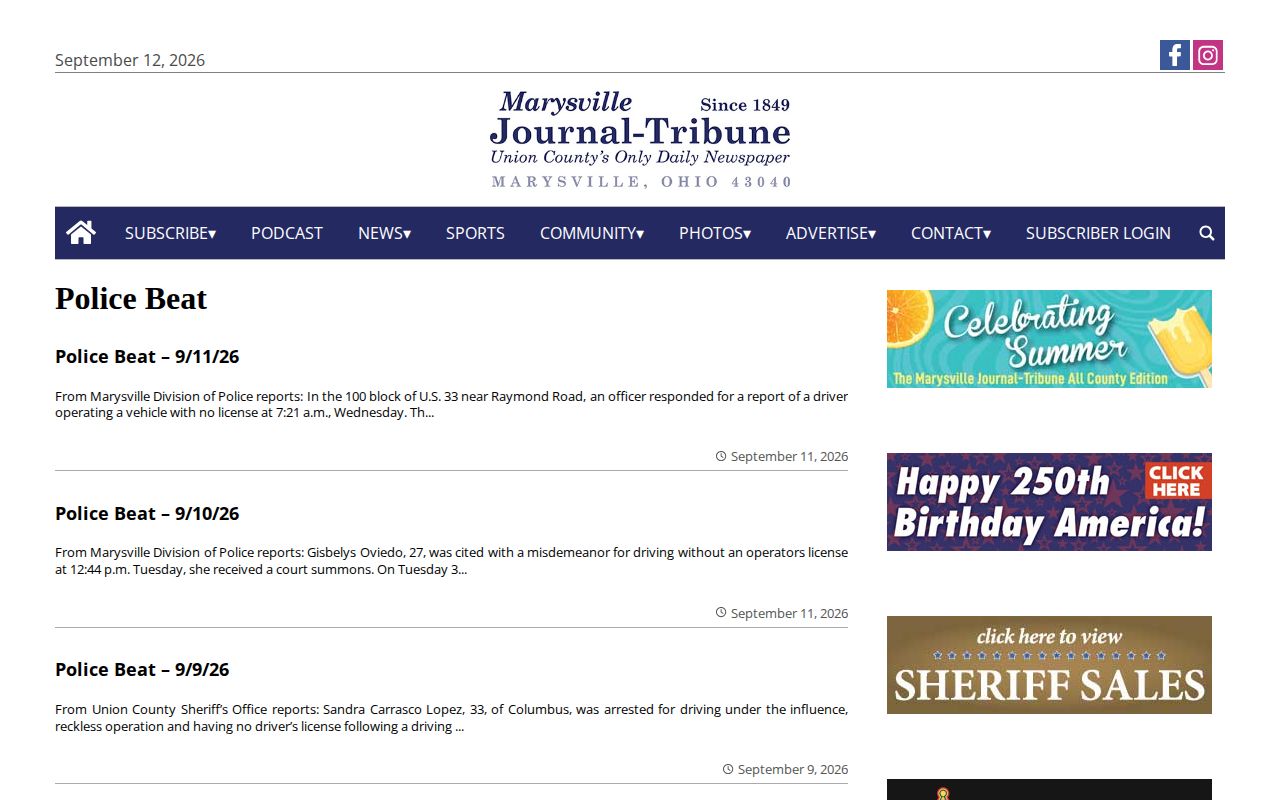
Article dates and source credits frame each summary. A representative Police Beat story shows the format, though it fixes neither present custody nor a complete booking total.
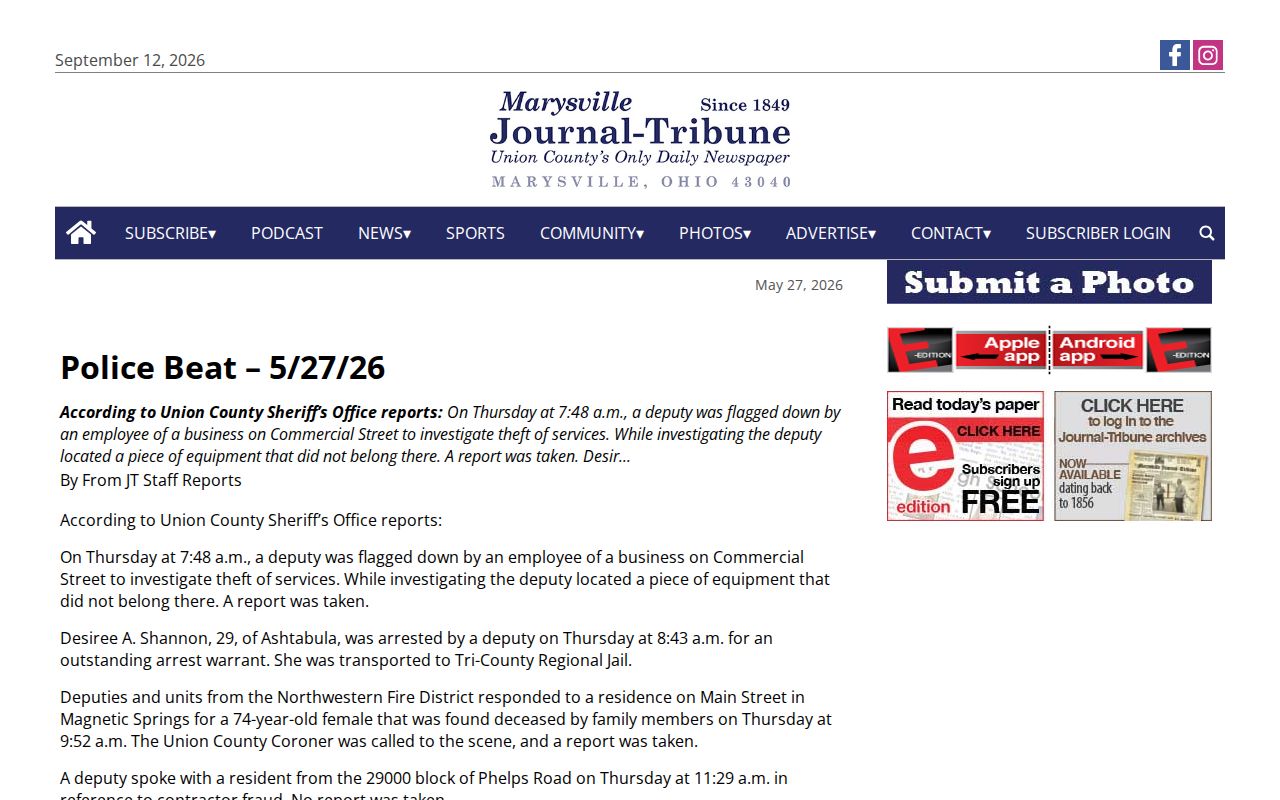
A news account explains the newspaper treatment. Check the facts against the agency's own record before relying on it.
Union County Log System Limits
The public Tri-County roster refreshes every 30 minutes and asks for a CAPTCHA. Its scope is current custody only. It is not a historical arrest log. The county's separate EvoGov booking page reports that booking is not enabled. That disabled page is neither an archive nor proof a date had zero arrests.
This split shapes any sound search. Daily Media answers what the Sheriff reported on a date. The roster answers who sits in custody at its latest refresh. Police Beat gives city and newsroom summaries. A records request retrieves a specific arrest record once web visibility ends.
- Blotter
- A dated summary of selected police activity, not a full jail ledger.
- Roster
- A current facility-status list that may change after release or transfer.
- Booking
- The jail intake process after custody is accepted.
- Disposition
- The later court outcome, separate from the original charge.
Note: Each source reflects a different agency, time window, and stage of the arrest-to-court process, so comparing them is part of any careful search.
Unofficial Union County Arrest Archives
Exhaust the official sources first. RecentlyBooked keeps a Union County page describing a 30-day window with several refreshes each day. Mugshots.com carries older Union County entries. Arrests.org exposes year-style county archive paths. All of them are unofficial. They can run stale and misstate custody, jurisdiction, charges, or case outcome.
BustedNewspaper lists no Ohio Union County section. Mugshots.zone offers no dedicated local section either, only a general page. County namesakes in other states are not substitutes. Treat none of these as the authoritative blotter.
A regional 95.3 WKTN report shows how news can reuse a Sheriff Daily Media account. It also notes a youth transport, a reminder that protected juvenile information never belongs in an adult-style booking profile.
Older Union County Arrest Records
Names drop off the live Union County roster once a booking is released. The online view has no set retention term. When an entry vanishes from the web list, the record itself usually still exists. It stays with the agency that made the arrest. The Sheriff handles county-created reports, while each city police department keeps its own arrest material. Disappearing from a website is not the same as legal destruction. For digging into older Union County arrests, the Union County Sheriff historical records page is the strongest starting point. It lists a jail-register index covering 1977 through 1982. Jail registers run from 1874 through 2000. A register entry may hold a name, a number, the arresting jurisdiction, and the offense. It may also carry commitment details, the confinement term, and discharge information. These are historical documents. Nobody will find modern booking photos there. The Union County Historical Society newspaper collection offers a different angle on the past. Its bound local newspaper volumes captured arrest reporting in the county as it happened. Scattered later issues did the same. Current jail records are not its job, though. For a modern booking, go first to Tri-County. The Sheriff, the arresting police department, or the court can also help. One more wrinkle deserves attention. Sealing and expungement orders control what can be disclosed later. A cached article or an old search result can linger after an official source changes. Stale web visibility proves nothing about whether the record remains open.